Element 4
Teachers communicate effectively with their students
I believe the classroom should be a place where students and teachers are equally engaged in communication. Communication can take on many forms in the classroom – such as discussion for learning, instruction, questioning, story telling and conversation. Communication by the teacher needs to be clear and open for reciprocation. I believe questioning needs to be planned, as Bobis, Mulligan and Lowrie (2004) encourage teachers to ask questions that require higher levels of thinking, not just the recollection of facts (p.277-8). I believe the teacher should provide opportunities to stimulate discussion with the students, between the students, and in a variety of manners (planned, reflective or responsive to the environment).
I have always communicated clear directions to students in terms of learning goals and instructions. The students know what they are learning and how they will be learning it, which was recognised by my co-operating teacher in the final report in 2007 (Evidence A).
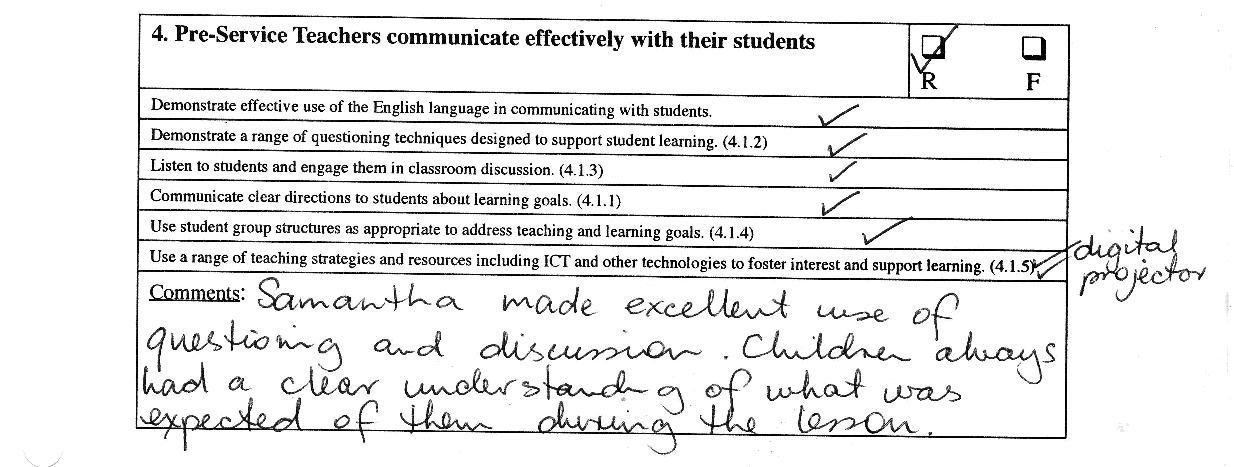
I have provided opportunities at the beginning of each lesson for students to become engaged in the topic through discussion and questioning of their prior knowledge. This enabled students to demonstrate their own understandings or experiences with the topic. Throughout the lessons, I have pre-planned suggested high-order questions to ask the students about the topic, and have been confident in my background knowledge in order to respond to questions that may arise about the topic from the students, or contribute new questions to a discussion. This is particularly evident in a maths lesson I taught to a small group of Year 3/4 students (Evidence B). The students were challenged to make links with their learning to their everyday lives. The Final Report from 2007 also supports this (Evidence A).
Evidence B - Maths Questioning
Mathematics
Stage: 2 Class: Topic: Measurement – Volume and Capacity
Working Mathematically – Reflecting and Applying Strategies
WMS2.5 Links mathematical ideas and makes connections with, and generalisations about, existing knowledge and understanding in relation to Stage 2 content
WMS2.2 Selects and uses appropriate mental or written strategies, or technology, to solve problems
Measurement – Volume and Capacity
MS2.3 Estimates, measures, compares and records volumes and capacities using litres, millilitres and cubic centimetres
|
Activity/purpose/Class structure |
Indicators |
Resources |
Assessment |
Introduction
Share names. Begin discussion of capacity.
Significant Questions:
· What is capacity? · Why do we need to know about it? · When do we use it in our everyday life? |
Able to: · Use prior knowledge to make connections to everyday life |
|
Answers to significant questions |
|
Activity 1 – Estimating and measuring 1L · Students pour/scoop water into a container, showing what they think 1L is · Teacher models actual amount of 1L in measuring jug Significant Questions: · Were you close to estimating an actual 1L? · Why do we need to know what 1L is? · What are some things we use that often come in 1L containers? |
· recognise that one litre containers can be a variety of shapes (Reflecting) · relate the litre to familiar everyday containers eg milk cartons (Reflecting) · estimating, measuring and comparing volumes and capacities (to the nearest litre) · using the abbreviation for litre (L) |
Several large containers 1L measuring jug Tap/sink Common 1L containers eg milk carton |
Strategies of estimation Answers to significant questions |
Activity 2 – Comparing to 1L
· Teacher shows 3 container of different size and shape – one is 1L, one is less than 1L and one is more than 1L
· Students predict which container is equal to 1L, and which ones are more/less than 1L. They note this on worksheet.
· Students devise a way to test which one is which
Specific questions for different groups:
· What do you think holds equal to/more than/less than 1L? · How can we test the actual answer? |
· using the abbreviation for litre (L) · using estimation strategies to determine 1L · using terms such as ‘equal to’, ‘more than’ and ‘less than’ |
3 containers (equal to, larger than, smaller than 1L) 1L measuring jug worksheets |
Answers to significant questions Worksheets Prediction strategies |
|
|
|
|
|
Activity 3 – Filling 1L
· Teacher shows a small container (between 100 and 300mL) and students predict how many of them it will take to fill the 1L measuring jug. Students note their predictions on their worksheet · Students test by pouring the filled container into the jug, and record the actual answer. · This is repeated with 2 more small containers Significant Questions: · Why did you predict that number? · Were you close? Why do you think you were/weren’t close? |
· estimate the number of cups needed to fill a container with a capacity of one litre (Applying Strategies) · using the abbreviation for litre (L) |
3 smaller containers 1L measuring jug Worksheets |
Answers to significant questions Worksheets Prediction strategies |
Evaluation of lesson
Were tasks appropriate for different abilities in class? Did they use their own strategies for measuring? What will this lead on to now? | |||
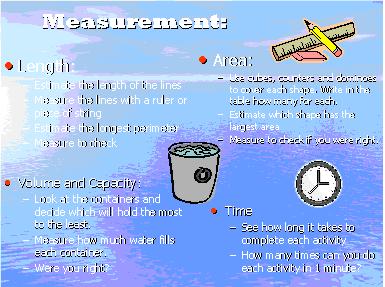
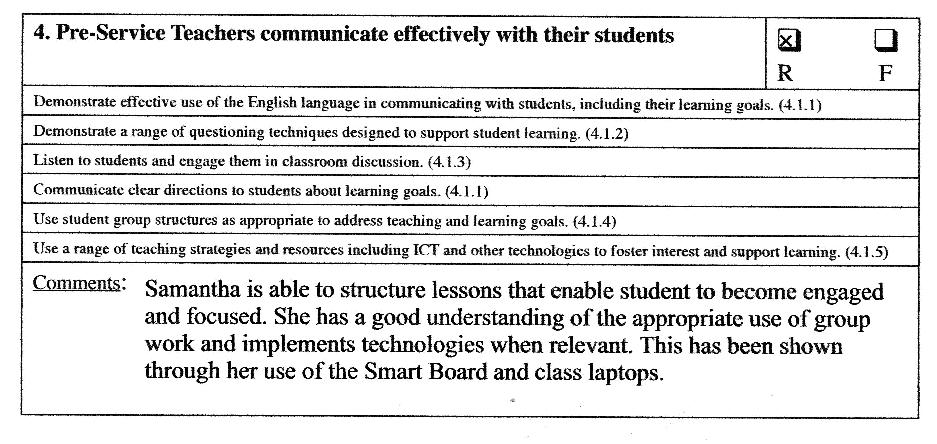
I have used a number of ICT and other technologies to facilitate student learning and communicate knowledge and instructions more clearly. For example, as students completed a number of mathematics activities at different stations, the students could refer back to a PowerPoint slide that was projected onto the whiteboard for reminders and hints about what to do (Evidence C). The Final report from 2008 also supports this (Evidence D).
Evidence C - Maths Rotations Slide
Evidence D - 2008 Final Report Comment
I will use groupings more effectively to facilitate meaningful discussion and engagement among the students. I need to use different grouping strategies on my next practicum so students spend time communicating with different peers, in order to develop their communication skills. Groundwater-Smith,
I will ensure that classroom discussion is appreciated by students. I need to encourage students to respond to each others’ ideas and views, by stimulating discussion where students’ ideas are explicitly used as a focus of the lesson. For example, a scaffolded debate in the classroom could be used, where students learn to listen to others’ ideas respectively. Listening skills need to be developed for this to be successful (Groundwater-Smith, Ewing & Le Cornu, 2003, p.228).

|
Element 4 Evidence.doc Size : 2.954 Kb Type : doc |
