Element 2
Teachers know their students and how they learn
I believe every student approaches learning in a different way – through ability, interest, motivation and prior knowledge. Groundwater-Smith,
I have always made an effort to learn students’ names early, having success through repetition of names when speaking to students and confirmation with the teacher. I have also taken the time to get to know the students through a casual discussion at the beginning of each day, as well as observation of friendship groups and lunchtime activities. Through this, I have been able to develop lessons that are relevant and engaging to the age group. For example, in a mathematics unit on ‘Money in Society’, the examples I used to consolidate learning involved situations the students could easily relate to (Evidence A).
Evidence A
Money in Society – Loss
Lesson Focus – To develop number skills for when dealing with money, and increase understanding and correct use of terminology when discussing money.
Links with previous/current learning (context and prior knowledge) –
- Understanding of dollar amounts
- Understanding of transfer of money during a purchase – from buyer to seller
Outcomes –
NS3.1 Orders, reads and writes numbers of any size
NS3.4 Compares, orders and calculates with decimals, simple fractions and simple percentages
WMS3.2 Applying Strategies - Selects and applies appropriate problem-solving strategies, including technological applications, in undertaking investigations
WMS3.5 Reflecting - Links mathematical ideas and makes connections with, and generalisations about, existing knowledge and understanding in relation to Stage 3 content
|
CONTENT OUTCOME |
Specific indicators of learning (Linked to Working Mathematically) |
Assessment Strategy |
|
NS3.1 |
• use large numbers in real-life situations eg population, money applications (Reflecting, Applying Strategies) |
Uses correct numerical representations of money amounts when answering questions |
|
NS3.4 |
• apply the four operations to money problems (Applying Strategies) |
Uses appropriate operations when calculating loss – ie cost – re-sale = loss |
Sequence of Learning Experiences –
|
TEACHER |
STUDENTS |
TIME |
RESOURCES |
|
Introduction (5 mins) | |||
|
Teacher introduces topic with a story. “Last year I bought an X-box for $400. Now, I want to sell it so I can get a Wii. My friend said he’ll buy it for $200. Is that less than what I paid for it? So am I making money or am I losing money?” |
Students contribute to story and give reasons. |
5 |
|
|
| |||
|
Introduction and discussion of term ‘loss’. Ask students what they think the definition is, and then create a class definition to write on board. - The formula: Cost price – re-sale price = loss |
Eg: When you buy something, and then sell it again, you probably can’t sell it for the same price you paid. So, if you sell it for a bit less, you will lose some money. This is called a “loss”. For example, you might buy a TV for $400, and then sell it in a few months for $300. That means you lost $100. Another way you can make a loss is if you pay lots of money to make something, but you sell it for less than what it cost to make it. For example, you might spend $50 to buy ingredients for a cake stall. But at the stall, you only make $30 from the cakes. So you lost $20. |
10 |
Board, chalk Maths workbooks, pens |
|
Teacher directs students to set of questions on board – set in 3 columns – basic, harder, challenging. |
Students attempt the questions. ** If students are having difficulty, they can join the teacher on the floor to go through questions together. |
20 |
Board, chalk Question sheet Maths workbooks, pens |
|
Conclusion (5 mins) | |||
|
Teacher and students mark the questions together, and share some on the ones they wrote themselves. |
Students take turns to answer questions. |
5 |
Maths workbooks, pens |
Extension –
Fast finishers can write a question for their partner, which they’ll share with the class at the end.
I have also taught three stages over the years on practicum, and developed an understanding of the different characteristics of each age group. I have become familiar with how each stage functions very differently in the classroom – whether it is how they learn, where they sit, their motivation levels for particular activities and behaviour management. This was recognised by my co-operating teacher’s final report (Evidence B).
Evidence B - 2007 Final Report Comment
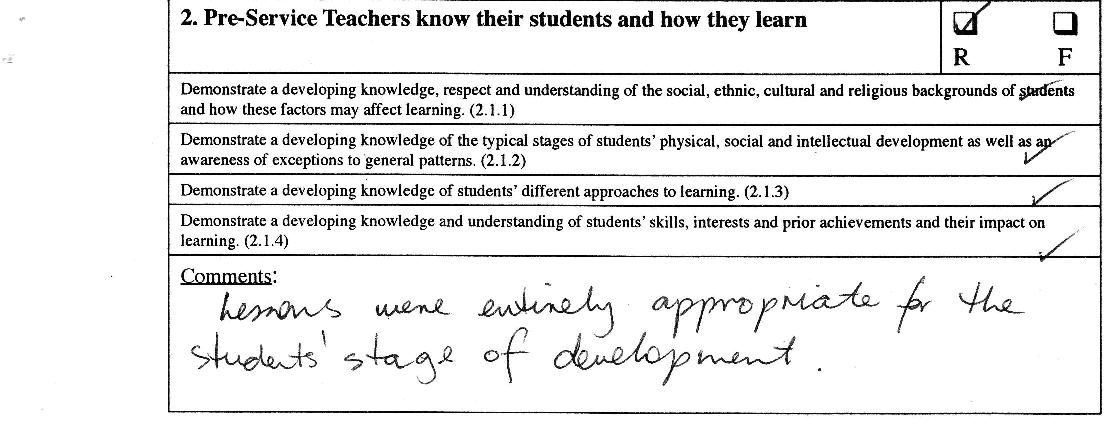
I have also used different approaches to learning throughout my lessons and units in order to cater for the wide variety of learners and approaches in the classroom. I have catered for this through discussion, notes on the board, visual assistance and practical learning experiences (Evidence C).
Evidence C - COGS Lesson Learning Styles
COGS Unit –
LESSON 1
Approach to learning â Using visual aids (pictures and photos) to assist identification and description of areas ß Approach to learning: Children on floor participating in discussion, adding notes to board
Sequence of Learning Experiences
|
TEACHER |
STUDENTS |
TIME |
RESOURCES |
|
Introduction (5 mins) | |||
|
Teacher leads discussion of the video yesterday, focusing on the environments. Teacher brings attention to 3 main ones – Alpine region, Limestone caves, |
Students help construct a list of some different environments mentioned in the video. |
5 |
|
|
| |||
|
Teacher leads brainstorm on each environment. Topics to discuss – what it looks like, interesting facts, what is the climate like, what people visit for. *Focus Qs: Eg. How is an alpine region different from a bush region? |
Students contribute their understanding, and observe images and photos to help describe each environment. They complete table on worksheet. |
10 |
Books, images of environments, board, markers, worksheets |
|
Focus now shifts to the fauna found in Kosciuszko. Teacher brings attention to 3 main animals – Corroboree Frog, Mountain Pygmy Possum, Bogong Moths. Topics to discuss – appearance, habitat, what it eats… |
Students brainstorm some animals found in Kosciusko, then contribute to discussion of 3 main animals. They complete table on worksheet. |
10 |
Books, images of fauna, board, markers, worksheets |
|
Teacher now introduces artmaking task. They remind students of different artmaking techniques – particularly use of tone and colour in drawing, brushstrokes in painting and textures in collage. * Teacher ensures room is ready for art prior to lesson. |
Students choose a flora or fauna to represent in an artwork. They can draw, paint or use materials for collage or use any combination to represent the features. Students can use the images of the flora/fauna to help them. |
40 |
Pencils, paints, brushes, glue, scissors, newspaper, crepe paper |
|
Conclusion (5 mins) | |||
|
Teacher asks students to share their artwork and describe a technique they used and why. |
Students describe how they used a particular technique to represent a feature of the flora/fauna. |
5 |
Artworks |
LESSON 2
Sequence of Learning Experiences
|
TEACHER |
STUDENTS |
TIME |
RESOURCES |
|
Introduction | |||
|
Teacher introduces the poem ‘The Man From Snowy River’ and leads a discussion. Have you heard of it? Have you read it? What do you think it is about? What does it have to do with Kosciuszko? *Show students $10 note |
Students contribute to a discussion about poem. |
5 |
Poem title on board. |
|
Main Body | |||
|
Teacher leads a reading of the last 3 stanzas of the poem (explaining what has happened so far). After the reading, the class looks back at each stanza and discusses any words they are not sure about (they can highlight them as they go). What happened? The class summarises the ending. |
Students read out loud 1 stanza at a time (choose or volunteer?) One student is the dictionary reader for any unsure words. |
15 |
Copies of the poem, highlighters |
|
Class looks at literary devices used in poetry – and revises meanings: - Rhyme, Simile, Metaphor, Descriptive adjectives and adverbials. As they go, the class identifies an example of this in the poem. |
Students fill out definitions and examples on worksheet |
10 |
Worksheets, pens |
|
Teacher now explains that they will write their own short poem- an acrostic poem – inspired by The Man from |
Students create their own acrostic poem. They can use words or phrases, different literary techniques etc to describe the topic. ** If students are having difficulty, they can come to the floor with the teacher to go through some more examples. |
25 |
HSIE or English books, pens Example on board |
|
Conclusion | |||
|
Teacher asks some students to share their poems. |
Several students share their poems. |
5 |
|
Approach to learning á Students work by themselves, but if they need assistance they move to the floor to work with teacher and others students
LESSON 3
Sequence of Learning Experiences
|
TEACHER |
STUDENTS |
TIME |
RESOURCES |
|
Introduction | |||
|
Class discusses the significance of tourism in the Kosciuszko area, and refreshes the activities you can do at the 3 regions in Kosciuszko. Teacher asks students where they could find information about these activities as if they were planning a holiday. EG: internet, travel agent, brochures, stories from family/friends… |
Students help construct a table of information about the activities one can do at Kosciuszko. Students discuss how they could find out about the activities and how to plan a holiday to Kosciuszko. |
5 |
Board, chalk |
|
Teacher explains that students are now going to make an information brochure to ‘sell’ one of the regions. Teacher asks students to think then share. After discussing how they might entice the reader, teacher leads discussion of good ‘selling’ words – ones that influence the reader. Some examples are written on the board. |
Students have a think to themselves about what region they might do, what activities they would talk about, and how they might entice the reader to go do them. |
5 |
Board, chalk |
|
Main Body | |||
|
The teacher asks the students to get into a pair and decide in the pair what region they will do. Teacher goes through what is to be include in the brochure – § The name/type of natural feature § A slogan for the region § Activities you can do there § Accommodation and package prices § Maps/pictures § A climate graph (statistics provided, but create own line graph) |
Students find a partner (or are given their PP partner) and decide what region they are doing. Students discuss and think about how they will include this in their brochure. |
10 |
Criteria sheet |
|
Teacher observes and assists beginnings of research on the area. Today, students will only start the research on activities and accommodation. |
Students begin to research the region, writing down or saving information about activities and accommodation. |
35 |
Computers |
|
Conclusion | |||
|
Teacher explains that this will be continued in the next COGS lesson, where they will continue research and begin putting together their brochure. That lesson will also be in the computer room so the teacher can demonstrate on Smart Board. |
5 |
| |
Approach to learning á Students work in pairs (and ended up in friendship pairs or pairs they had done computer work with before)
Approach to learning â Students begin discussion on floor as a whole class, then move to individual work. However, they can discuss with their table partner
LESSON 4
Sequence of Learning Experiences – Part 1
|
TEACHER |
STUDENTS |
TIME |
RESOURCES |
|
Introduction | |||
|
Class discusses what they have learnt so far about Kosciuszko National Park (KNP): - Where it is - What environments/flora/fauna are there - What activities you can do there Teacher now explains that the class will look at a map of KNP and do some activities about direction, distance and other map features. |
5 |
| |
|
Main Body | |||
|
Teacher introduces and class discusses skill for each of the following (eg on board): - Co-ordinates - Direction (Never Eat Soggy Weetbix) - Key/Legend - Scale – 1.5cm = 10km |
10 |
Board, chalk | |
|
Teacher introduces worksheet with a quick explanation of each section. Teacher observes and assists where needed. |
Students set to work with their map and worksheet |
35 |
Maps Worksheets Pens Rulers String |
|
Conclusion | |||
|
Class marks the worksheet. Teacher explains that the students should remember and practice their mapping skills as they will be involved in a survivor race using mapping skills later that day! |
10 |
Worksheets | |
Sequence of Learning Experiences – Part 2
|
TEACHER |
STUDENTS |
TIME |
RESOURCES |
|
Introduction | |||
|
Teacher reminds students that they will now be using their mapping skills – in a survivor type adventure around the school! Students will be in teams (4-6) and be given a set of directions. As they follow their directions, they will pick up clues. When they have all their clues, they must piece them together to discover the final clue – a question. The first team to return to the start point with all clues and the correct answer to the question wins! (The answer is the code to unlock a box of prizes). The catch- the team will be attached by a skipping rope, so they must work together in order to succeed! |
|
| |
|
Main Body | |||
|
Teacher goes over rules – students must stick together and follow their directions, they must piece them together to find the final clue and question, they must all contribute to the task and all finish together to win! |
|
| |
|
Conclusion | |||
|
Class discusses what went well in the task, what made them slow down etc. |
|
| |
Approach to learning á Students apply their mapping skills to a practical situation, which enables them to make relevant use of their knowledge and consolidate skills
I will make explicit links in my lesson plans and units to students’ prior learning, expectations of outcomes and differentiation for learning, as per the Quality Teaching Framework (NSWDET, 2003). I need to make observations of students, have conversations with my co-operating teacher and examine past and current units of work to determine prior learning, expectations of outcomes and differentiate learning.
I will also see how Stage 1 operates and make distinct the qualities and characteristics of this age group compared to others. I need to carefully observe and reflect on the Stage 1 age group and draw similarities and differences to other Stages, as McInerney and McInerney (2006) recognise that cognition, social context and developmental level of the child are important to consider for effective teaching.

|
Element 2 Evidence.doc Size : 1.337 Kb Type : doc |
