Element 3
Teachers plan, assess and report for effective learning
I believe planning is fundamental to providing students with lessons that relate to the syllabus, are sequential in order and allow room for timely feedback to students and parents. Calling on prior knowledge is a useful tool before building new knowledge, as it can ‘act as a springboard for further learning’ (McInerney & McInerney, 2006, p.103), and thus should be included when planning. I believe students need to hear regular feedback in order to feel confident in the areas they have achieved and know how to improve the areas they are not so confident in. In order to do this assessment needs to be relevant to the learning. Groundwater-Smith,
I have developed several units of work across different KLAs that all follow a logical sequence of learning experiences, with knowledge developing over the course of the unit. I taught a COGS unit of work on my last practicum on Kosciuszko National Park (KNP) and it is an example of how I have planned and assessed for effective learning (Evidence A). The unit included clear goals as to what was to be learned by the students, which was recognised in my final report by my co-operating teacher (Evidence B). The goals were linked to syllabus outcomes and assessed accordingly. Each lesson in the unit sequence required students to recall and analyse knowledge from the previous lesson or their own prior knowledge in order to show their understanding of the concepts and apply this to the new learning experience.
Evidence A - COGS Unit Plan and Assess
COGS Unit –
Lesson Focus –
To explore the main flora and fauna present in
Links with previous/current learning (context and prior knowledge) –
- Students have viewed video on
Outcomes –
HSIE-
ENS3.6 Explains how various beliefs and practices influence the ways in which people interact with, change and value their environment
Creative Arts-
VAS3.1 Investigates subject matter in an attempt to represent likenesses of things in the world
VAS3.2 Makes artworks for different audiences, assembling materials in a variety of ways
|
OUTCOME |
Specific indicators of learning |
Assessment Strategy |
|
ENS3.6 |
- Identifies key features of an alpine environment and the fauna that lives there |
Contribution to discussion of different environments and fauna in Kosciuszko, including observation of images and comparison of features |
|
VAS3.1 |
- Represents the qualities of the natural and built environments using a variety of techniques |
Use of different artmaking techniques to represent the chosen flora or fauna |
|
VAS3.2 |
- Makes an artwork responding to the natural and built environment using a variety of media |
Use of different materials to represent the qualities of the chosen flora or fauna |
Extension – Students who finish fast can write a description of their artwork – outlining the features of the flora/fauna and how the art techniques represented them.
Evaluation –
Did the students recall information from the video?
Were students engaged in discussion about the flora and fauna?
Did the students progress well onto the artworks, using the information discussed?
Did the students use interesting techniques to represent features?
Were students engaged in the artmaking process?
Sequence of Learning Experiences
|
TEACHER |
STUDENTS |
TIME |
RESOURCES |
|
Introduction (5 mins) | |||
|
Teacher leads discussion of the video yesterday, focusing on the environments. Teacher brings attention to 3 main ones – Alpine region, Limestone caves, |
Students help construct a list of some different environments mentioned in the video. |
5 |
|
|
| |||
|
Teacher leads brainstorm on each environment. Topics to discuss – what it looks like, interesting facts, what is the climate like, what people visit for. *Focus Qs: Eg. How is an alpine region different from a bush region? |
Students contribute their understanding, and observe images and photos to help describe each environment. They complete table on worksheet. |
10 |
Books, images of environments, board, markers, worksheets |
|
Focus now shifts to the fauna found in Kosciuszko. Teacher brings attention to 3 main animals – Corroboree Frog, Mountain Pygmy Possum, Bogong Moths. Topics to discuss – appearance, habitat, what it eats… |
Students brainstorm some animals found in Kosciusko, then contribute to discussion of 3 main animals. They complete table on worksheet. |
10 |
Books, images of fauna, board, markers, worksheets |
|
Teacher now introduces artmaking task. They remind students of different artmaking techniques – particularly use of tone and colour in drawing, brushstrokes in painting and textures in collage. * Teacher ensures room is ready for art prior to lesson. |
Students choose a flora or fauna to represent in an artwork. They can draw, paint or use materials for collage or use any combination to represent the features. Students can use the images of the flora/fauna to help them. |
40 |
Pencils, paints, brushes, glue, scissors, newspaper, crepe paper |
|
Conclusion (5 mins) | |||
|
Teacher asks students to share their artwork and describe a technique they used and why. |
Students describe how they used a particular technique to represent a feature of the flora/fauna. |
5 |
Artworks |
COGS Unit –
Lesson Focus –
To develop skills in reading and writing poetry, with a focus on literary devices.
Links with previous/current learning (context and prior knowledge) –
- Students have viewed video on
Outcomes –
HSIE-
§ ENS3.6 Explains how various beliefs and practices influence the ways in which people interact with, change and value their environment
English-
§ TS3.1 Communicates effectively for a range of purposes and with a variety of audiences to express well-developed, well-organised ideas dealing with more challenging topics.
§ RS3.8 Identifies the text structure of a wider range of more complex text types and discusses how the characteristic grammatical features work to influence readers’ and viewers’ understanding of texts.
§ WS3.9 Produces a wide range of well-structured and well-presented literary and factual texts for a wide variety of purposes and audiences using increasingly challenging topics, ideas, issues and written language features.
|
OUTCOME |
Specific indicators of learning |
Assessment Strategy |
|
ENS3.6 |
- examines how natural, cultural, religious, historical, economic and political factors can influence people’s interactions with environments |
Identifies how the stockmen used the land |
|
TS3.1 |
- joins in group or individual recitations of a variety of familiar and new poems (including students’ own poems) |
Contributes to reading of The Man From Snowy River, listening to other readers and using a clear, interesting voice when reading. |
|
RS3.8 |
- discusses how certain literary devices are used in poems, eg simile, metaphor, alliteration, assonance |
Looks at particular words or phrases and identifies the literary device, discussing how/why they are used to portray the story. |
|
WS3.9 |
- produces a range of short poems |
Writes their own short poem based on The Man From Snowy River |
Sequence of Learning Experiences
|
TEACHER |
STUDENTS |
TIME |
RESOURCES |
|
Introduction | |||
|
Teacher introduces the poem ‘The Man From Snowy River’ and leads a discussion. Have you heard of it? Have you read it? What do you think it is about? What does it have to do with Kosciuszko? *Show students $10 note |
Students contribute to a discussion about poem. |
5 |
Poem title on board. |
|
Main Body | |||
|
Teacher leads a reading of the last 3 stanzas of the poem (explaining what has happened so far). After the reading, the class looks back at each stanza and discusses any words they are not sure about (they can highlight them as they go). What happened? The class summarises the ending. |
Students read out loud 1 stanza at a time (choose or volunteer?) One student is the dictionary reader for any unsure words. |
15 |
Copies of the poem, highlighters |
|
Class looks at literary devices used in poetry – and revises meanings: - Rhyme, Simile, Metaphor, Descriptive adjectives and adverbials. As they go, the class identifies an example of this in the poem. |
Students fill out definitions and examples on worksheet |
10 |
Worksheets, pens |
|
Teacher now explains that they will write their own short poem- an acrostic poem – inspired by The Man from |
Students create their own acrostic poem. They can use words or phrases, different literary techniques etc to describe the topic. ** If students are having difficulty, they can come to the floor with the teacher to go through some more examples. |
25 |
HSIE or English books, pens Example on board |
|
Conclusion | |||
|
Teacher asks some students to share their poems. |
Several students share their poems. |
5 |
|
Extension –
Students who finish early can begin to type up their poem on the classroom computers.
Evaluation –
Did the students know about the poem?
Did they predict what it would be about?
Did the students enjoy the poem? Did they get involved in reading and listening to the poem?
Did the students identify and give examples of literary devices used in the poem?
Were the students keen to write their own poem? Did they have difficulty?
Information about The Man From
- Written by A.B. (Banjo)
- First published in the April 1890 edition of The Bulletin (Australian news magazine)
-
- Banjo Paterson and TMFSR are commemorated on the $10 note.
- There have been 2 movies, a television series and a stage production based on the poem
- The poem is about a colt horse that escapes. But it is very valuable, so the owner puts a price on its return. So all the horse riders in the area go out to search for it, but only the very brave can handle the steep slopes of Kosciuszko.
Follow up lesson (as not completed last time) –
|
TEACHER |
STUDENTS |
TIME |
RESOURCES |
|
Introduction | |||
|
Class re-visits The Man From Snowy River poem. What was it about? What were some of literary techniques and examples we discussed? |
5 |
Poem and worksheet | |
|
Main Body | |||
|
Teacher explains that students are now going to write their own poems about Kosciuszko. Teacher refers students to 2 example poems on the board: A beautiful place to go, With a variety of flora and fauna, I bet you’ll see some snow! The Mountain Pygmy Possum, It’s as little as a mouse, They live high up in trees, Or even the attic of your house! |
Students look at the example poems and discuss the rhyming pattern and other literary techniques. They discuss how else you could describe the Kosciuszko NP in a thoughtful and exciting way in a poem. |
10 |
Board, markers |
|
Teacher asks students to talk to the person next to them about what they might focus on in the poem – eg an environment, an activity, an animal etc… They share ideas with the class. |
Students discuss with each other what they might do and share with the class. |
5 |
|
|
Teacher directs students to their desks to begin writing their own 4 line poem that rhymes. ** If students are having difficulty, they can come to the floor with the teacher to go through some more examples. |
Students write their own poem based on KNP. They can do a general poem, or focus on a particular element. |
30 |
|
|
Conclusion | |||
|
Teacher asks students to volunteer to read their poems. |
Several students read their poems. |
10 |
|
Extension –
Students who finish early can begin to type up their poem on the classroom computers.
COGS Unit –
Lesson Focus –
To use information learnt about Kosciuszko to create a tourist information brochure on a particular region.
Links with previous/current learning (context and prior knowledge) –
- Students have viewed video on
- Students are familiar with researching and publishing material on computers, including internet searches, organising text and images and creating graphs.
Outcomes –
HSIE- Environments
ENS3.5 Demonstrates an understanding of the interconnectedness between
English-
WS3.12 Produces texts in a fluent and legible style and uses computer technology to present these effectively in a variety of ways.
Maths- Data
DS3.1 Displays and interprets data in graphs with scales of many-to-one correspondence
|
OUTCOME |
Specific indicators of learning |
Assessment Strategy |
|
ENS3.5 |
• locates and describes patterns of human involvement in environmental areas of |
Identifies and explains the opportunities for human involvement in the Kosciuszko region. |
|
WS3.12 |
§ varies font and layout to suit particular audience and purpose § chooses appropriate graphics to accompany text § creates texts that incorporate graphics or tables when appropriate. |
Uses the computers successfully to create an interesting and informational brochure with appropriate graphics |
|
DS3.1 |
• naming and labelling the horizontal and vertical axes of line graphs • drawing a line graph to represent any data that demonstrates a continuous change |
Uses excel to produce a line climate graph |
Sequence of Learning Experiences – Lesson 1
|
TEACHER |
STUDENTS |
TIME |
RESOURCES |
|
Introduction | |||
|
Class discusses the significance of tourism in the Kosciuszko area, and refreshes the activities you can do at the 3 regions in Kosciuszko. Teacher asks students where they could find information about these activities as if they were planning a holiday. EG: internet, travel agent, brochures, stories from family/friends… |
Students help construct a table of information about the activities one can do at Kosciuszko. Students discuss how they could find out about the activities and how to plan a holiday to Kosciuszko. |
5 |
Board, chalk |
|
Teacher explains that students are now going to make an information brochure to ‘sell’ one of the regions. Teacher asks students to think then share. After discussing how they might entice the reader, teacher leads discussion of good ‘selling’ words – ones that influence the reader. Some examples are written on the board. |
Students have a think to themselves about what region they might do, what activities they would talk about, and how they might entice the reader to go do them. |
5 |
Board, chalk |
|
Main Body | |||
|
The teacher asks the students to get into a pair and decide in the pair what region they will do. Teacher goes through what is to be include in the brochure – § The name/type of natural feature § A slogan for the region § Activities you can do there § Accommodation and package prices § Maps/pictures § A climate graph (statistics provided, but create own line graph) |
Students find a partner (or are given their PP partner) and decide what region they are doing. Students discuss and think about how they will include this in their brochure. |
10 |
Criteria sheet |
|
Teacher observes and assists beginnings of research on the area. Today, students will only start the research on activities and accommodation. |
Students begin to research the region, writing down or saving information about activities and accommodation. |
35 |
Computers |
|
Conclusion | |||
|
Teacher explains that this will be continued in the next COGS lesson, where they will continue research and begin putting together their brochure. That lesson will also be in the computer room so the teacher can demonstrate on Smart Board. |
5 |
| |
Extension-
Students will only begin research in this lesson, but if working well can continue to research more than just the activities and accommodation if they finish.
Evaluation-
Did the students recall the activities you can do in each region?
Did they work well finding partners and deciding on a region?
Did the students begin their research in appropriate places – ie open a search engine and enter an appropriate search text?
Some good selling words:
- Historical
- Exciting
- Interesting
- Beautiful
- Luxurious
- Inexpensive
- Relaxing
- Adventurous
Sequence of Learning Experiences – Lesson 2
|
TEACHER |
STUDENTS |
TIME |
RESOURCES |
|
Introduction | |||
|
Teacher reiterates the importance of writing succinct information in their own words. |
8 |
Laptops | |
|
Main Body | |||
|
Students continue research on the Kosciuszko area. Teacher observes and assist where necessary, and writes any significant websites found on the board. |
50 |
Laptops | |
|
Conclusion | |||
|
Students save work and log off computers. |
2 |
Laptops | |
Sequence of Learning Experiences – Lesson 3
|
TEACHER |
STUDENTS |
TIME |
RESOURCES |
|
Introduction | |||
|
Teacher demonstrates how to apply a brochure to Microsoft Publisher. Teacher shows template – colour and design changes etc. |
Class moves to computer room and sits on floor in front of smart board. |
8 |
Computers, smart board |
|
Main Body | |||
|
Teacher observes and assists students where necessary. At times, it may be useful to draw classes attention to demonstrate a certain skill on the smart board. Full attention must be gained before proceeding. |
Students move to computers in pairs to begin applying the information they have researched into the brochure. |
50 |
Computers, smart board |
|
Conclusion | |||
|
Students save work and log off computers. |
2 |
Computers | |
Sequence of Learning Experiences – Lesson 4
|
TEACHER |
STUDENTS |
TIME |
RESOURCES |
|
Introduction | |||
|
Teacher shows students an example of a finished brochure. |
Students observe and improve understanding of what is expected. |
8 |
Laptops |
|
Main Body | |||
|
Teacher observes and assists students where necessary. AT times it may be necessary to refer back to example. Full attention must be gained before proceeding. |
Students work in pairs on laptops and attempt to finish brochure. |
50 |
Laptops |
|
Conclusion | |||
|
Students save work and log off computers. |
2 |
Laptops | |
COGS Unit –
Lesson Focus –
To build skills of reading maps through understanding geographical tools in relation to
Links with previous/current learning (context and prior knowledge) –
- Familiarity with
Outcomes –
HSIE- (Environments)
ENS3.5 Demonstrates an understanding of the interconnectedness between
Maths- (Space and Geometry)
SGS3.3 Uses a variety of mapping skills
|
OUTCOME |
Specific indicators of learning |
Assessment Strategy |
|
ENS3.5 |
- Uses complex mapping key, symbols and scale to locate features on a map |
Uses mapping skills to correctly find and identify features – both on the map and in the real world. |
|
SGS3.3 |
- using scale to calculate the distance between two points on a map - locating a place on a map which is a given direction from a town or landmark |
Answers questions about a map correctly after using mapping skills. Locating new clues based on directions. |
Part I
Sequence of Learning Experiences
|
TEACHER |
STUDENTS |
TIME |
RESOURCES |
|
Introduction | |||
|
Class discusses what they have learnt so far about Kosciuszko National Park (KNP): - Where it is - What environments/flora/fauna are there - What activities you can do there Teacher now explains that the class will look at a map of KNP and do some activities about direction, distance and other map features. |
5 |
| |
|
Main Body | |||
|
Teacher introduces and class discusses skill for each of the following (eg on board): - Co-ordinates - Direction (Never Eat Soggy Weetbix) - Key/Legend - Scale – 1.5cm = 10km |
10 |
Board, chalk | |
|
Teacher introduces worksheet with a quick explanation of each section. Teacher observes and assists where needed. |
Students set to work with their map and worksheet |
35 |
Maps Worksheets Pens Rulers String |
|
Conclusion | |||
|
Class marks the worksheet. Teacher explains that the students should remember and practice their mapping skills as they will be involved in a survivor race using mapping skills later that day! |
10 |
Worksheets | |
Extension –
Students who finish the first page move onto the extension questions on the back.
Evaluation –
How much did the students recall about KNP?
How much did the students know about mapping?
Did the students actively involve themselves in the mapping process?
How well did the students locate and measure features?
Part II
Sequence of Learning Experiences
|
TEACHER |
STUDENTS |
TIME |
RESOURCES |
|
Introduction | |||
|
Teacher reminds students that they will now be using their mapping schools – in a survivor type adventure around the school! Students will be in teams (4-6) and be given a set of directions. As they follow their directions, they will pick up clues. When they have all their clues, they must piece them together to discover the final clue – a question. The first team to return to the start point with all clues and the correct answer to the question wins! (The answer is the code to unlock a box of prizes). The catch- the team will be attached by a skipping rope, so they must work together in order to succeed! |
|
| |
|
Main Body | |||
|
Teacher goes over rules – students must stick together and follow their directions, they must piece them together to find the final clue and question, they must all contribute to the task and all finish together to win! |
|
| |
|
Conclusion | |||
|
Class discusses what went well in the task, what made them slow down etc. |
|
| |
Evaluation –
How did they enjoy it?
Did the students follow the rules and follow the map correctly?
Did they figure the answer to the question?
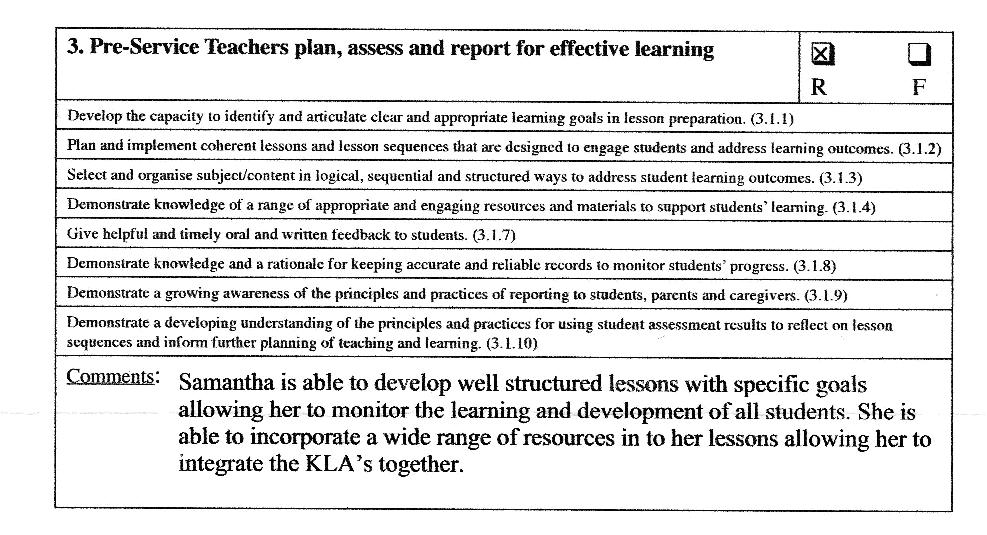
I have also used a wide variety of resources in these sequenced lessons in order to develop understanding, engagement and different learning experiences for the students. Fleer and Jane (2004) remind us that technology is not just high technology – such as computers – but the use of materials, and any invention that assists in a process. The KNP unit of work (Evidence A) involved use of classroom laptops (including internet searches and publishing programs like Publisher, Word and Excel), visual resources and art resources to represent features of KNP. Other examples of using resources included a mathematics lesson of station rotations, using measuring instruments, water troughs and everyday classroom items to give students a practical hands-on experience for learning (Evidence C).
Evidence C - Maths Rotations
Maths Rotations
|
Mathematics |
Stage: 2 |
|
Measurement |
Grade: 3/4 |
Lesson Focus – To develop skills across a range of mathematical areas in measurement, including length, area, volume and capacity and time, through group activities and practical investigations.
Links with previous/current learning (context and prior knowledge) –
- Experience working with the mathematical areas
- Understanding of units of measurement including centimetres, metres, minutes…
- Previous lessons on mass as an introduction to practical mathematical lessons
Outcomes –
MS2.1 Estimates, measures, compares and records lengths, distances and perimeters in metres, centimetres
MS2.2 Estimates, measures, compares and records the areas of surfaces in square centimetres and square metres and millimetres
MS2.3 Estimates, measures, compares and records volumes and capacities using litres, millilitres and cubic centimetres
MS2.5 Reads and records time in one-minute intervals and makes comparisons between time units
|
OUTCOME |
Specific indicators of learning |
Assessment Strategy |
|
MS2.1 |
• recording lengths or distances using centimetres and millimetres eg 5 cm 3 mm • estimating and measuring the perimeter of two dimensional shapes • select and use an appropriate device to measure lengths or distances (Applying Strategies) |
Estimates the length of the lines or perimeters, and correctly measures them to check answers. Chooses a ruler or string to appropriately measure lengths. |
|
MS2.2 |
• recognising the need for the square centimetre as a formal unit for measuring area • estimating, measuring and comparing areas in square centimetres • discuss strategies used to estimate area in square centimetres or square metres eg visualising repeated units (Communicating, Reflecting) |
Uses the items to measure and compare the areas, recognising the cubes to be 1cm squared. |
|
MS2.3 |
• recognising the need for a formal unit to measure volume and capacity • estimating, measuring and comparing volumes and capacities (to the nearest litre) • explain the need for a standard unit to measure the volume of liquids and the capacity of containers (Communicating) |
Estimates and compares volumes, using measuring cups to check answers. Uses the correct terminology for discussing volume. |
|
MS2.5 |
• recording digital time using the correct notation eg 9:15 • discuss time using appropriate language (Communicating) |
Uses the correct terminology when talking about time, and writes answers with the correct notation. |
Sequence of Learning Experiences –
|
TEACHER |
STUDENTS |
TIME |
RESOURCES |
|
Introduction – gain interest, set the scene… (5 mins) | |||
|
Teacher introduces maths activities with a short discussion about measurement. What is it? What can we measure? Teacher explains that there will be four stations of activities, and runs through each one with the aid of a PP slide. What units do we use for each type of measurement? Note on board. The students will conduct an investigation and answer the questions. |
Students contribute to discussion about measurement, and ask any questions. |
5 |
PP slide |
|
| |||
|
Teacher explains that after 10 mins they will move on to a new station. Teacher organises students into groups and sends each one off to a station. Teacher will work with volume and capacity station. |
Students get into their groups and move to their starting station. Students work at each station for 10 mins, conducting the practical investigations to answer the questions on the worksheet. Students may refer back to the PP slide for directions. |
40 |
PP slide, worksheets, pens/pencils. Length- rulers, pieces of string Area- cubes, counters, dominoes Volume and Capacity- 5 containers of varying size, measuring cup, sink Time- stopwatches, puzzle, book |
|
Conclusion (10 mins) | |||
|
Teacher asks students to help pack up the equipment and then calls students back to floor. Continue discussion about measurement, discussing the answers to the questions (but not marking). |
Students pack up equipment then move to floor, and participate in further discussion about measurement, relating their experiences on the four stations. |
10 |
|
Extension –
Students will be working in groups so should all finish at the same time. However, those who are more competent can aid others in the group with investigations and explanations.
References –
Lilburn, P. & Rawson, P. (2000).
Evaluation –
What did the students already know about measurement?
Did they use the correct terminology for each type?
Did they enjoy the activities?
Did they behave well in a practical situation?
I have also explored with varied approaches to assessment. I used observation, discussion and work samples to assess student achievement of outcomes. One lesson in the KNP unit of work (Evidence A) had a practical experience to assess learning. Students had been learning mapping skills (mathematics outcome) in relation to a map of KNP. The following lesson involved an ‘Amazing Race’ throughout the school. Students, in teams, had to find clues by following directions on a map. Students were assessed to have achieved the outcomes if they completed the course correctly with all clues collected. The Amazing Race is an example of authentic assessment, as students are being assessed with practical tasks that reflect the actual learning.
I will, on my next professional experience, follow through on assessment of learning with reporting, through more explicit and regular feedback to students. I will give individual and group feedback through returning work samples to students with productive and individualised feedback, as well as have class discussion about things the students did well or areas they may need more encouragement with. In order to do this I need to get advice from the co-operating teacher on how they give feedback to students, and ensure I report back to students after each lesson on how they went.
I will be more involved in reporting to parents and also learn more about half-yearly and yearly reports. I need to get more involved in observing or assisting with development of half-yearly and yearly reports, as well as make myself known to parents by sending a letter home to introduce myself as a student teacher, along with work samples. I need to be familiar with the new reporting system by reading the Curriculum Planning and Programming, Assessing and Reporting to Parents K-12 Policy (NSWDET, 2006).

|
Element 3 Evidence.doc Size : 1.411 Kb Type : doc |
